Music Theory 7 songs featuring Mixolydian mode The dominance of the major and minor modes in Western classical music has been observed for several centuries, and this… October 12, 20202 comments
Music Theory Subtonic and leading-tone in cadences Depending on the interval sequences of a particular diatonic scale, the seventh scale degree can be called subtonic or… September 24, 2020
Music Theory 5 songs featuring Dorian mode Out of all seven diatonic scales, the major and minor scales have been the two most prevalent in Western music… August 30, 2020
Music Theory Popular songs using Lydian mode In Western music, the vast majority of classical compositions and popular songs are written using only two diatonic… July 26, 20206 comments
Music Theory Deceptive cadence: chord progressions and song examples In music, cadences play a crucial role in the organization of musical phrases and sentences. The concept of cadences is… July 9, 2020
Music Theory Locrian mode: music examples and harmonic structure Music theory describes seven diatonic scales of which the major and minor scales are the most functional and therefore… June 17, 2020
Music Theory Supertonic chords: types and usage In musical theory, the supertonic is the second degree of a diatonic scale—the scale that consists of seven notes per… June 4, 2020
Music Theory Picardy third: cadence for a happy ending in classical music and popular songs In musical theory, the term Picardy third is used to refer to a special way of ending a minor piece with a major chord… May 13, 2020
Music Theory Popular songs featuring Phrygian mode and Neapolitan chord Western music theory describes seven diatonic scales that are the basis of corresponding musical modes, among which the… April 29, 2020
Music Theory Mixolydian mode: famous examples in classical and pop music In the 17th century, the major and minor scales became the basis for almost all classical music compositions. This… April 5, 202013 comments
Music Theory The Andalusian cadence: distinct chord progression of flamenco that captivated all pop music genres The Andalusian cadence is a musical term denoting a chain of four chords that appear sequentially through each step of… March 15, 2020
Music Theory Microtonality: the variety of approaches to microtonal music in world cultures In theory, microtonal music describes a piece that contains one or more intervals measuring below a semitone. Although… February 19, 2020
Nature Sounds Crickets choir: musical examples imitating rhythmic patterns of chorusing insects One of the most mesmerizing sounds in nature is the bizarre rhythmic patterns generated by chorusing insects. While… February 9, 20201 comment
Music Theory Lydian mode: famous examples throughout the music history Major and minor modes are the most used diatonic scales in classical and popular music due to their versatile structure… January 12, 2020
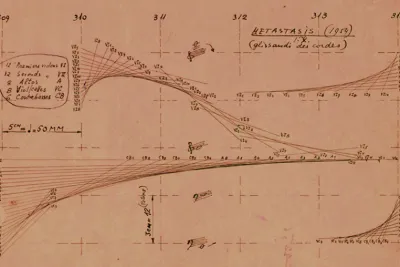
Orchestra The symbiosis of music and architecture in mathematical glissandi by Iannis Xenakis The rapid growth of technology in the 20th century led to the beginning of a new era in the music industry when the… December 8, 20193 comments
Music Theory Classic examples of the Phrygian mode through the music eras From Middle Ages to modernity, Western music has been largely based on diatonic scales that organize seven notes into… August 24, 20194 comments
Nature Sounds Why birds sing their songs: great maestros proving the musicality of nightingale, cuckoo, yellowhammer It is no coincidence that the sounds emitted by birds are known in many languages as "songs", rather than simple animal… June 23, 20191 comment