SONGWRITER
Lamento Boliviano: meaning and origin of the Mendoza rock anthem
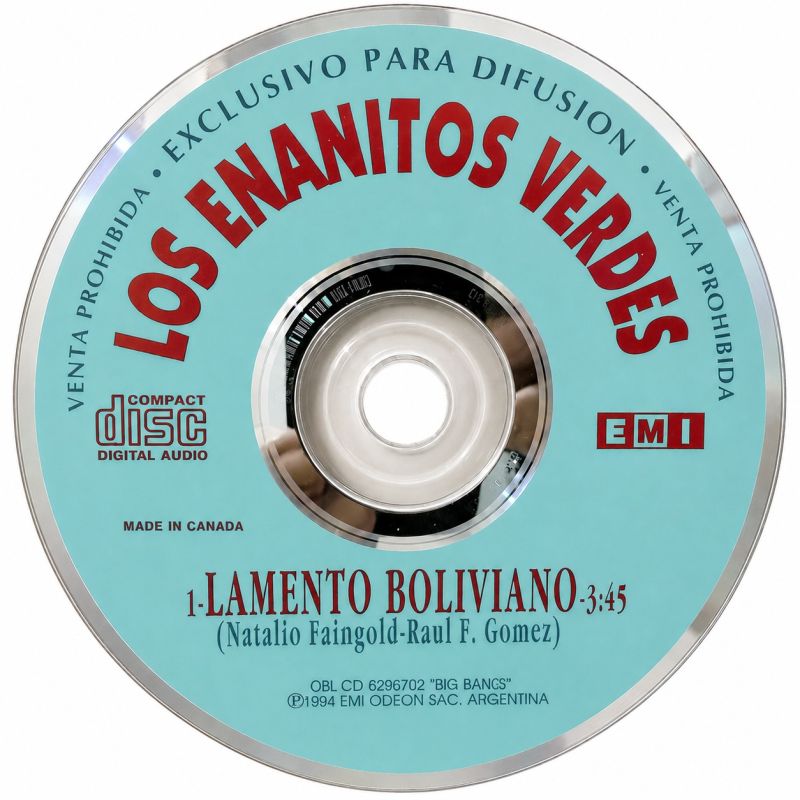
Lamento Boliviano CD cover

By Serg Childed
Lamento Boliviano became the best-known song in the repertoire of the Argentine rock band Los Enanitos Verdes after appearing on their 1994 album Big Bang. The song, however, began earlier in the same Mendoza rock scene as a composition by Alcohol Etílico, written by Natalio Faingold and Raúl Federico Gómez, known as Dimi Bass. Los Enanitos Verdes transformed that local song into one of the most recognizable anthems of rock en español, carried by its Andean-flavored introduction, direct guitar pulse, and the rough emotional force of Marciano Cantero's voice.
The title translates as Bolivian Lament, and the phrase already gives the song its emotional frame. The lyrics show a narrator trying to appear hard and immovable while admitting that pain, alcohol, and confusion have taken over. Instead of a polished love confession, the song offers a compact image of wounded pride: someone who wants to resist being shaken, yet ends up singing from inside the very collapse he denies.
This open emotional design helps explain the song's long public life. Lamento Boliviano can be heard as heartbreak, homesickness, drunken bravado, or a shared late-night release, which is why it works so easily in karaoke, campfire, bar, and concert settings. Its popularity also turns on the strange force of a cover that outgrew its source without erasing it: a Mendoza song became a Latin American common possession.
Listen to Los Enanitos Verdes perform Lamento Boliviano:

From a compositional standpoint, Lamento Boliviano combines the Aeolian mode with the harmonic minor scale, a common but powerful technique in many Latin pop and rock hits. In general, the track is accompanied by three main chords of E Aeolian: Em, Am, and Bm, representing the tonic, subdominant, and dominant areas of the mode. At key moments, however, the song uses the authentic cadence Em-B7-Em from the harmonic minor scale, balancing the closure of musical phrases with the closure of poetic phrases.
This structure is typical enough to be read easily by the ear, but expressive enough to create a strong emotional response. The Aeolian material gives the song its natural-minor sadness, while the harmonic-minor cadence adds direction, tension, and release. That clear harmonic frame helps explain why Lamento Boliviano can feel instantly familiar, even before the listener thinks about the words.
For those intrigued by the Aeolian minor mode, consider delving into further compositions and exploring their harmonic analysis through the articles listed below:
- 8 songs to introduce Aeolian mode and natural minor scale
- 6 songs combining harmonic minor and Aeolian mode
- Mariposa Traicionera: meaning and flamenco roots of Maná's top hit
- Livin' la Vida Loca: why is Ricky Martin's best song so catchy?
- A Dios le Pido: Juanes' Spanish lyrics behind the song success
- Suavemente: meaning of Elvis Crespo's best song
- El Farsante and 7 more songs by Ozuna in Dorian and Aeolian modes
- La Gota Fría: vallenato music masterpiece refashioned by Carlos Vives
- Vivir Mi Vida: meaning and origin of Marc Anthony's jubilant salsa