


Take Five: the jazz standard built in five

- Country:
- USA
- Genre:
- Jazz
- Musical Modes:
- Phrygian Mode, Aeolian Mode
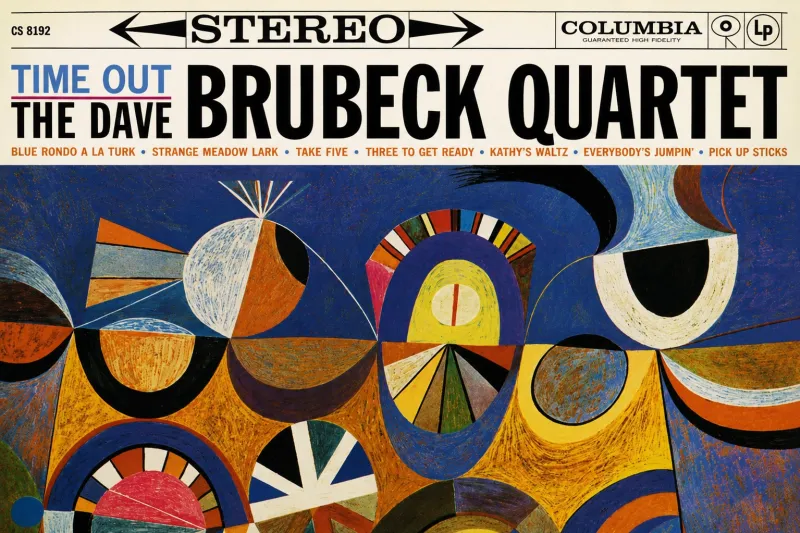
Take Five became the signature piece of the Dave Brubeck Quartet after appearing on the 1959 album Time Out. Written by saxophonist Paul Desmond, the track turned an unusual five-beat meter into one of the most recognizable shapes in jazz. Its title is a plain joke on the meter, but the record itself made 5/4 feel natural rather than experimental.
The piece works because it is not only clever. Desmond's alto saxophone melody is cool, narrow, and easy to remember, while Dave Brubeck's piano keeps the repeating pattern firm underneath it. Joe Morello's drum solo gives the rhythm a public face: the listener hears the five-beat cycle not as a classroom idea, but as motion, balance, and swing.
Take Five also changed the public life of modern jazz. Time Out was built around unusual meters, but this track crossed far beyond the album's concept, becoming a radio hit, a television theme, a concert staple, and a shorthand for urbane mid-century jazz. Its popularity helped prove that odd meter could enter popular memory when the groove and melody were clear enough.
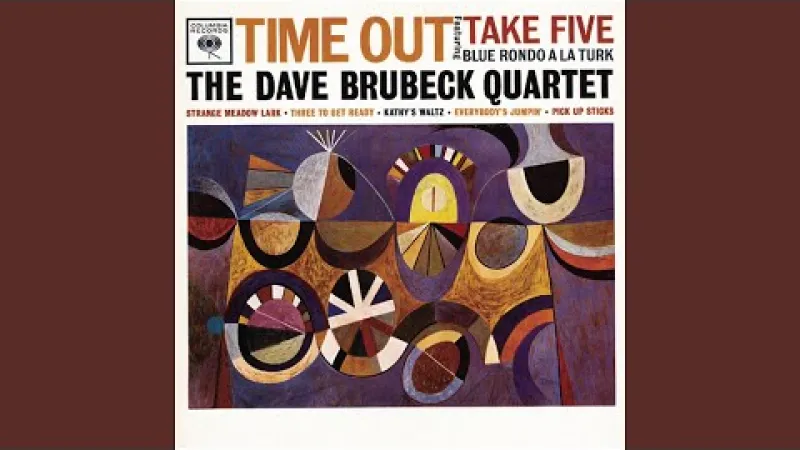
Listen to the Dave Brubeck Quartet perform Take Five:
From a compositional standpoint, Take Five is centred in Bb minor and can be read through the Aeolian mode. The verse is built on a two-chord plagal movement, while the chorus opens into richer harmonic colour.
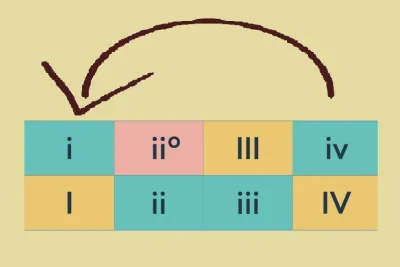
In the harmonic analysis of the song's chord chains, the scale degrees, denoted with Roman numerals, show the following progressions in Bb minor.
Verses:
- Bbm–Ebm or i–iv
Chorus:
- Bbm–Cbmaj7–Abm7–Bbm7 or i–IImaj7–vii7–i7
- Ebm7–Abm7–Db7–Gbmaj7 or iv7–vii7–III7–VImaj7
- Gbmaj7–Cbmaj7–Abm7–Bbm7 or VImaj7–IImaj7–vii7–i7
- Ebm7–Abm7–Fm7–Bb7 or iv7–vii7–v7–I7
The chorus immediately brings in the Neapolitan colour through Cbmaj7, the flattened second degree of Bb Aeolian. This sonority belongs to the same expressive family as the Phrygian pull from i to II, familiar from classical and Spanish-influenced minor-mode writing. At the very end, the only full authentic cadence in the song arrives through Fm7–Bb7, giving the form a final sharpened turn before it returns to the main minor world.
For those intrigued by minor-mode harmony and unusual tonal colour, consider exploring the following articles:
- 8 songs to introduce Aeolian mode and natural minor scale
- 6 songs combining harmonic minor and Aeolian mode
- Popular songs featuring Phrygian mode and Neapolitan chord
- Aeolian mode in Led Zeppelin songs
- Beatles songs in harmonic minor and Aeolian modes
- El Farsante and 7 more songs by Ozuna in Dorian and Aeolian modes
You may also like
Saxophone Nelson's time in the Marines inspired his future composer career
Music Theory Popular songs featuring Phrygian mode and Neapolitan chord
Saxophone Pixinguinha: Brazilian saxophonist who established choro music as a pop genre
Music Theory Plagal cadence exemplified by 9 songs in all diatonic modes
Music Theory Popular songs showing the submediant chord in all diatonic modes
Music Theory Things We Said Today: the only Beatles song featuring Phrygian mode