Sea Shanty
Barrett's Privateers: origins and meaning of famous drinking song
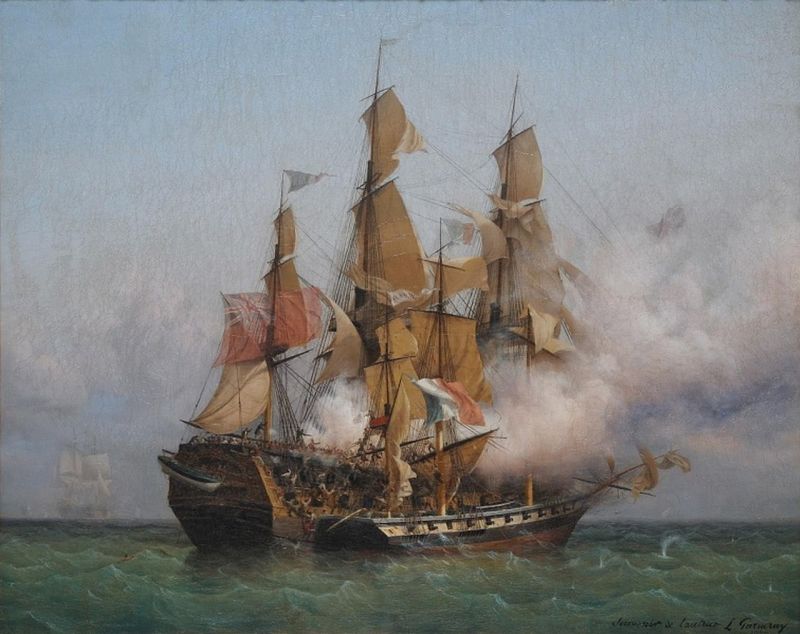
Kent battling Confiance by Ambroise Louis Garneray

By Serg Childed
Barrett's Privateers, released in 1976 by Stan Rogers—Canadian folk musician and songwriter whose musical career was cut short by an aviation accident—remains his best-known song to date, at least among the general public. Styled as a sea shanty, Barrett's Privateers first appeared on Rogers' debut album Fogarty's Cove and quickly gained popularity as a drinking song.
It should be noted that the term 'sea shanty' as we understand it today entered widespread use in the mid-19th century and described a special genre of work songs designed to synchronize the sailors as they handled the rigging on tall ships. These energetic choral songs retain sufficient popularity now, although the objective need for them has disappeared, along with the commercial application of the sailing ships themselves.
The term privateer—the English analog of the German word kaper and the French corsaire—was used for a private person or ship commissioned by the government of a country to attack enemy ships, for which the captains were supplied with a letter of marque distinguishing privateers from ordinary pirates acting independently.
The rather lengthy Barrett's Privateers (nine stanzas interspersed with a chorus) tells the story of a young sailor hired to serve on Antelope, a battered privateer ship captained by the titular Elcid Barrett, that would soon sink in the aftermath of its first battle with a heavily armed American vessel. As the lone survivor of the tragedy, the narrator, who lost both legs in battle, laments his choice to embark on this voyage, saying that he was lured into it through deceit. Although the characters in the story are complete fiction (as well as the story itself), Rogers clearly drew inspiration from the very historic realities of 18th century privateering.
Listen to Barrett's Privateers by Stan Rogers:
Compositionally, Barrett's Privateers is written in the Ionian diatonic mode and is performed a cappella—the term that came to mean unaccompanied vocal music, i.e. a singer or a singing group performing without any instrumental accompaniment.
To understand how Barrett's Privateers can be performed with just three primary chords in the key of C major, be sure to listen to the version recorded by the Scottish folk group The Corries:
The technique of harmonizing a song melody with just three primary chords of the Ionian mode is extremely common in many genres of pop music. Here are some of our articles that explore this subject in more depth:
- Beatles songs composed with just three primary chords
- 6 songs to unpack Ionian mode and the major scale
- Ramblin' on My Mind: Delta blues masterpiece cut in a hotel room
- Terraplane Blues: first song to compare car problems with intimate relationship
- Bony Moronie: blues roots of the seminal rock and roll hit
- Yakety Yak: teenager's answer to household chores in a hit song
- Tumbling Dice: hundred reels of tape for a messy Rolling Stones mix
- Statesboro Blues: no one can sing the blues like Blind Willie McTell
- Marie Laveau: ballad of the legendary Voodoo Queen


I was in Owen Sound, Ontario in August of 1976, and was fortunate enough to hear Stan perform Barrett's Privateers, just a few weeks after Stan wrote the song.
The story I heard at the time was that the Friends of Fiddlers Green and a few others were getting seriously pissed at the Northern Lights festival in Sudbury in July of that year, as is the custom at folk festivals, and a drunken challenge was issued to write a sea shanty. There has been a great deal of speculation about the amount of beer involved but Barrett's Privateers was the result of that challenge and the rest, as they say, is history.
Stan joked about this during his performance in Owen Sound.
I was probably somewhat chemically imbalanced at the time but that is my recollection.